
Periscope Up!
On exploring the depths

One of the aspects of Substack I like is that it attracts people who seek deeper reflection. In contrast with most social media posts, which take a nanosecond to scan, a reader generally spends a few minutes with the posts that attract his or her attention. It doesn’t seem like much, but in some important ways, it is.
Many years ago, I developed a book concept that I never finished, titled “Periscope Up.” Somewhere in my computer files I probably have 25K words and a dozen chapters written before my brain squirreled elsewhere, but I believe the topic is worth sharing.
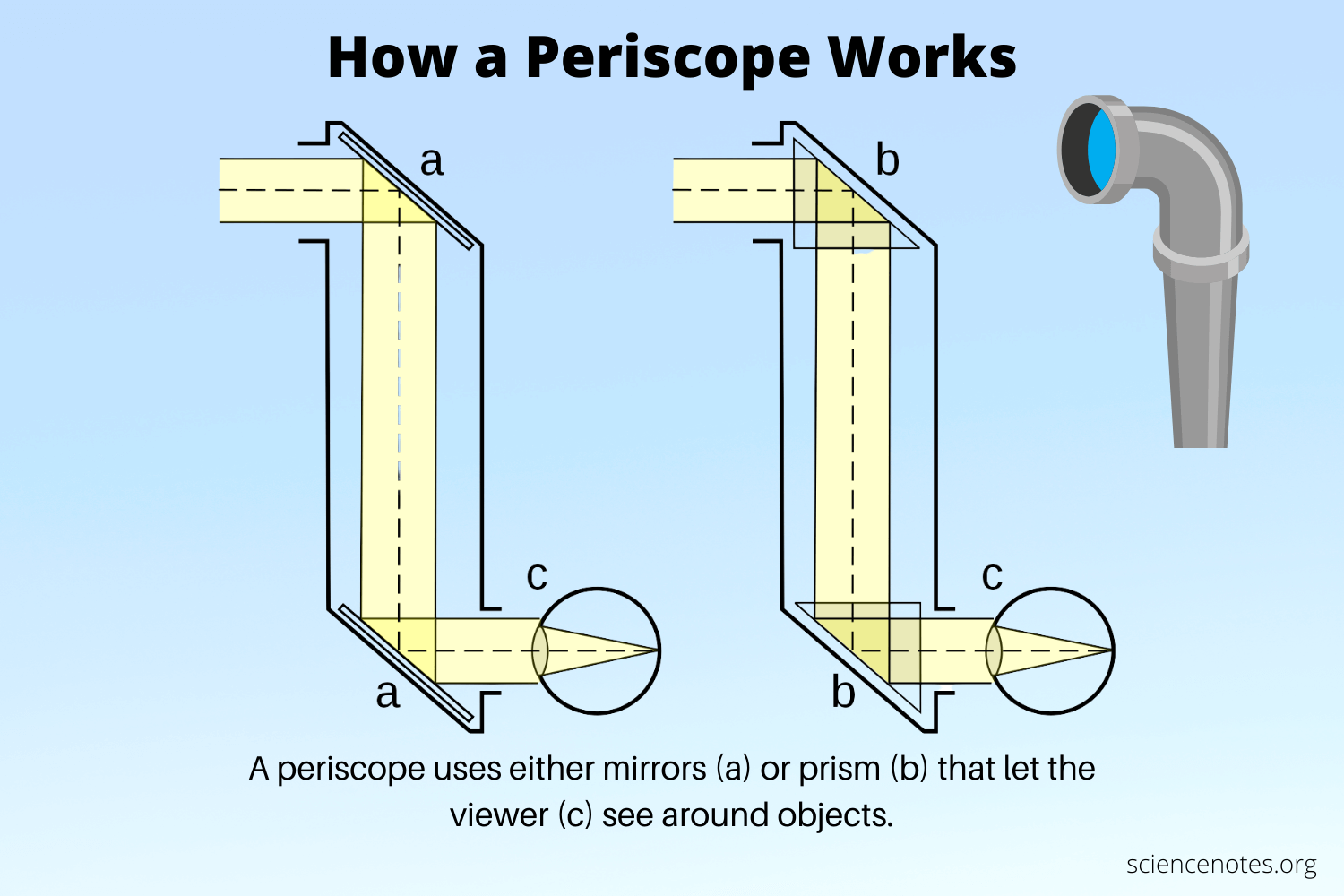
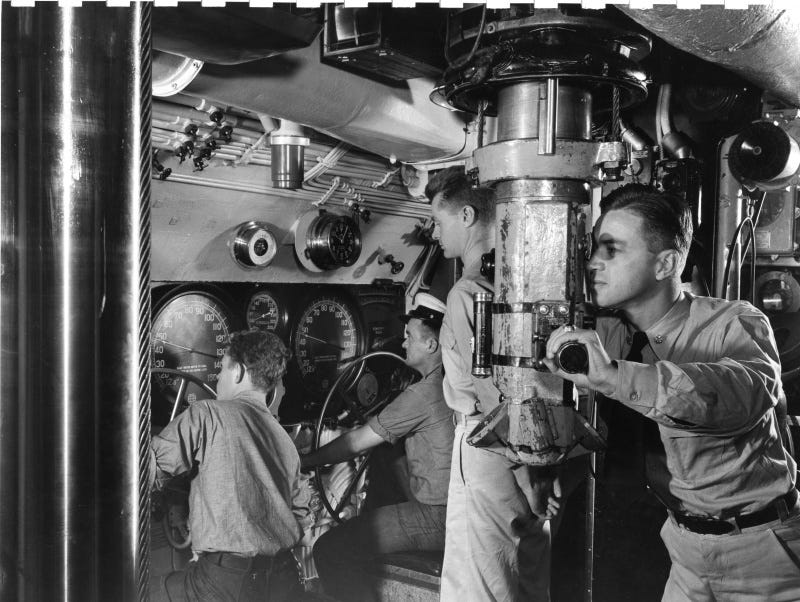
First, rather than assume that everyone knows what a periscope does, in short, it’s a long tube with two refracting mirrors used by a submarine to assess threats and tell where it’s going. A much better explanation of how they work can be found here. Why is this important for a submarine? Because it operates in the deep, below the surface. I wouldn’t be surprised if the name “Substack” is a bit of a nod to this notion.
Living in the depths
If we lived a couple of hundred years ago, we’d come across occasional newsstands, and engage with others about what was going on in the wider world at best a few times a week, but most of our time would have been devoted to the dailies – physical work, cooking, cleaning, plowing, etc. Doing stuff. I was raised in the seventies and eighties, and even then, we seemed to have more balance with the way we spent our time. Getting on my bike after school and disappearing for hours doing who knows what.
Now, it seems most people I know are on high alert far too often – with their periscopes up. Talking about whatever is in the public sphere, trying to be “in the know” about:
Whatever Trump/Johnny Depp/Ye/Musk/JLo has done in the last 15 minutes,
Whichever viral video made everyone laugh today, or
Whichever news story we need to be most outraged over.
Have any interaction with a friend or stranger these days, and we all have this common language about whatever has been in the public view in the last few days. “You haven’t seen the #thingofthemoment? Where’ve you been?”
I think we know what happens when we’re constantly on high alert – our systems start to crash. Anxiety, health problems, depression. Because we’re out of balance. Our bodies and brains need feeding. We need to get back on task in the depths, where we belong. Where we accomplish meaningful things. Where we get in touch with our true selves.
“The world as we have created it is a process of our thinking. It cannot be changed without changing our thinking.”
― Albert Einstein
Down periscope
So what does this mean?
First, to be clear, we’re not really talking about submarines and periscopes. That’s a visual prop. We’re talking about finding balance by spending more time in the depths.
Like exercise, we need to find sufficient time in each day to at least acknowledge our inner world – at a minimum. But for a deeper, more meaningful sense of purpose, exploring our thoughts, feelings, intentions, motivations, and beliefs, without interruption, for a longer period of time than we give it now.
I can’t tell you how much time you’ll need. Maybe you need a weeklong meditation retreat. Maybe you just need 15 minutes a day. Probably somewhere in between. At the very least, we all need to put down our devices far more often. And yes I’m talking to myself as well.
That doesn’t mean putting our heads in the sand. But seriously, we do not need to be on high alert 24/7. It’s not sustainable, or helpful.
I have a very strong pull to be near the ocean. Yes, I also love the mountains and lakes, but the ocean has a special healing power for me, which I think is because like our bodies, it seems to breathe. In and out. It has a rhythm that synchs with our own. Calms me. Connects me to the eternal nature of life.
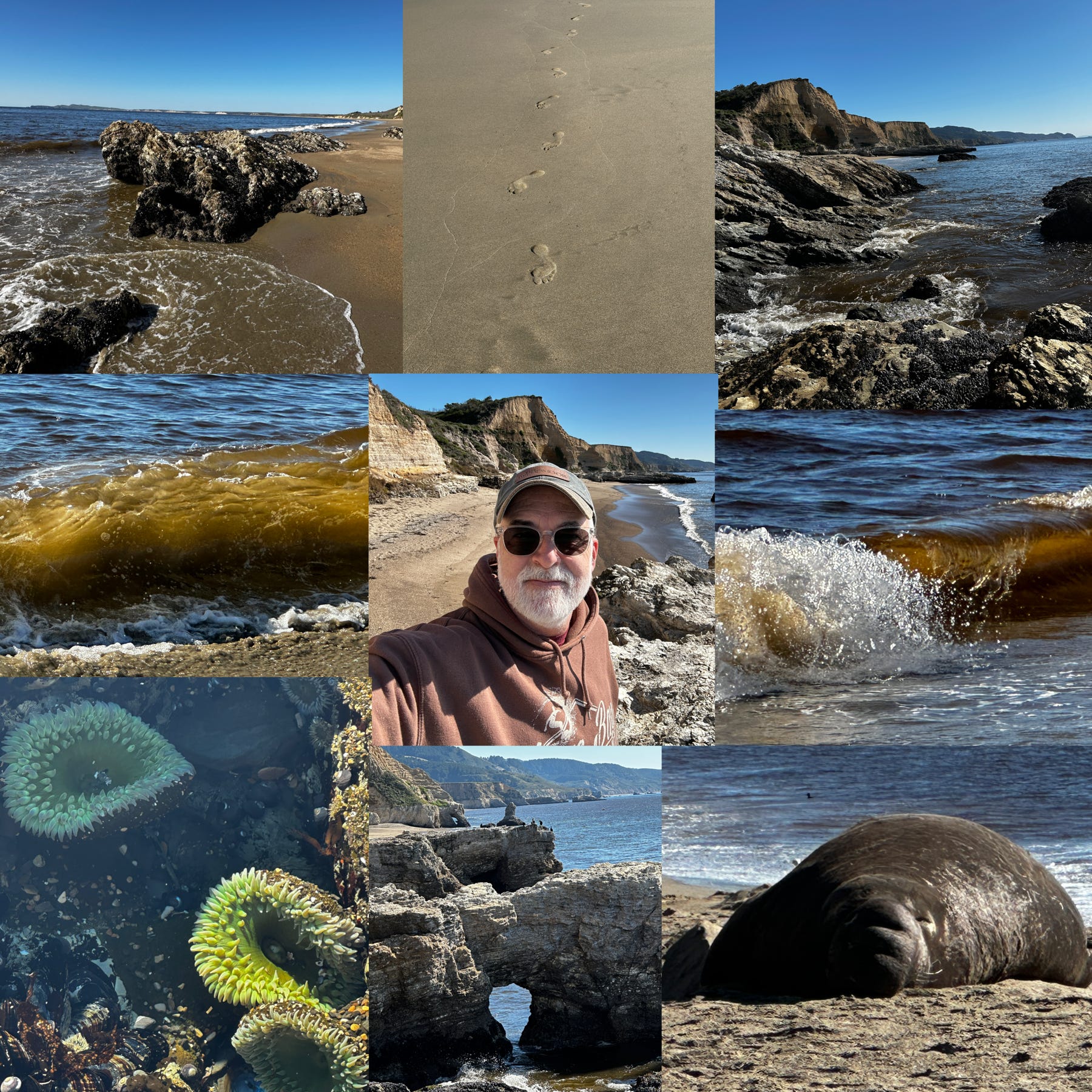
I took my kids to the beach all the time. I got married on the beach. After my dad died earlier this year, I took a day to myself and walked up a remote beach in silence, and just listened to the waves, to the stream of thoughts, images and inspirations that passed through my consciousness. Unusually, I even came across a lone elephant seal sunning itself on the beach.
I didn’t see him check his socials even once.
“The mind is not a vessel to be filled, but a fire to be kindled.”
― Plutarch
The ocean of your mind
Oceans cover approximately 70% of the earth’s surface, and more life exists there than anywhere else on the planet. Its surface area is about 360 million square kilometers (139 million square miles), and it’s average depth is 3,682 meters (12,080 feet) filled with life. Scientists estimate there may be between 700,000 and 1 million species in the ocean (mostly animals and excluding most microorganisms, of which there are millions). Roughly two-thirds of these species, possibly more, have yet to be discovered or officially described, with almost 2,000 new species accepted by the scientific community each year (Source: NOAA)
According to NOAA, as of June 2024, 26.1% of the global seafloor had been mapped with high-resolution technology. Despite this, the majority of our ocean is largely unknown. I think it surprised many of us when Malaysia Airlines Flight 370 disappeared in 2014, with all 239 of its passengers vanishing. It still hasn’t been found. The ocean is vast.
Isn’t this a lot like our minds?
Neuroscientists know much about our brain architecture, including how connections form between neurons, how neural pathways are strengthened and how the brain reorganizes itself throughout our lives. Like with the sea floor, with recent technology, scientists are able to see brain activity in real time, to see which neural connections are being lit up. The physical parts of the brain can be scanned, identified, tracked and influenced.
But what about consciousness? The state of being aware of our own existence, perceptions, and thoughts. Not so much. Often referred to as “qualia”, the way in which we experience our own state of being remains a mystery from the earliest days of human existence. Though it interests many people, its exploration is much like the exploration of the ocean’s depths. There is so much to be explored and learned, we know there’s something out there, and yet we spent an inordinate amount of time watching naked people try to survive in the wilds together.
Where has our sense of adventure gone? Our sense of curiosity, of discovery, of wonder? In the early 1900s, every Caractacus Potts was out there inventing contraptions that are today part of our every day lives. What happened? Everything has not been invented or discovered. Surely, there’s something more meaningful and useful we can do with our spare moments than doomscrolling and reaching for the edibles.
I don’t have all the answers. I just think we need to renew our childhood sense of wonder and explore what else is possible.
Some time back, PBS issued a dubbed video of Mr. Rogers singing “Garden of your Mind” - if you haven’t watched it, please check it out. Brilliant, simple inspirational wisdom.

Let’s take a step back, put down our periscope, put down our phones, and sit quietly with our wise minds, as much as we need, as long as we need. Witness the breathing of the ocean’s waves. Witness our own breathing. Wake up to the sounds of birds outside. Feel the warmth of the sun on our skin. Sit quietly in a park and listen.
It was enough to fill our minds and souls two hundred years ago, and it’s more than enough today.
“You rarely have time for everything you want in this life, so you need to make choices. And hopefully your choices can come from a deep sense of who you are.”
― Fred Rogers

What a clever way to articulate how 'in the know' and alert we always feel we have to be. Being present and in the moment is something I'm working at. Having those deep moments is so satisfying, they just take more effort sometimes which is why we opt for that immediate social media hit. I want to earn that dopamine the right way not the cheap way. Thank you for the read. I bet the elephant seal was impressive to come by too!